
Introduction
Your store can record a real order while Google Analytics 4 misses the purchase completely.
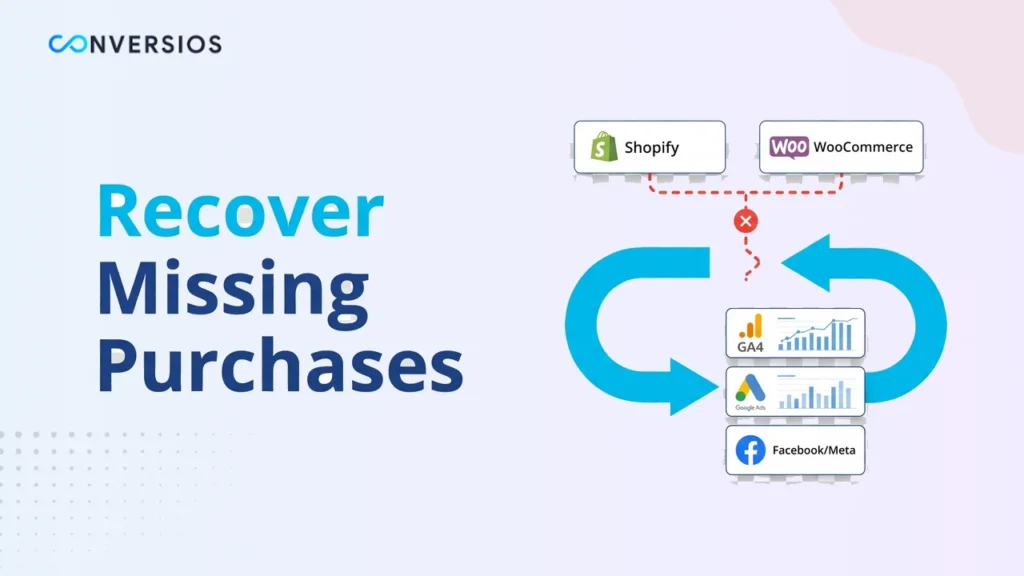
That gap usually starts at the last step of the journey. The shopper pays, the platform creates the order, but the purchase signal never reaches analytics because the thank-you page does not load properly, loads too late, or is bypassed by a redirected checkout flow. The result is familiar: Shopify or WooCommerce shows the order, while GA4, Google Ads, or Facebook/Meta reports come in low.
Order Recovery Engine exists for that exact problem. It adds a recovery layer inside Conversios Server Side Tracking so a missed purchase signal does not have to stay missing forever.
What is Order Recovery Engine?
Order Recovery Engine, or ORE, is a recovery workflow inside Conversios Server Side Tracking. Its job is to identify completed orders that did not survive the normal purchase-event path, recover that missed order data inside the server-side setup, and strengthen downstream measurement across GA4, Google Ads, and Facebook/Meta.
In the current Conversios positioning, ORE is available across the three-platform measurement path covering GA4, Google Ads, and Facebook/Meta.
The approved proof points for this explainer are specific: Conversios reports up to 98% matching between recovered GA4 purchase data and backend order data, and Google Ads can record up to 30% additional conversions when valid missed orders are recovered through the wider server-side setup.
That matters because the native purchase-event moment is fragile. Many tracking setups still depend on the customer reaching the final confirmation or thank-you page cleanly enough for the event payload to fire. If that last step breaks, the store can keep the revenue while analytics loses the conversion signal.
ORE does not replace the main purchase event. It backs up the event path when the normal post-purchase signal is missed.
Who is Order Recovery Engine for?
Order Recovery Engine is for merchants and marketers who need stronger purchase-signal reliability across both Shopify and WooCommerce.
- Stores that compare platform orders against GA4 and keep finding purchase gaps
- Teams relying on Google Ads or Facebook/Meta optimization that becomes weaker when purchases are undercounted
- Brands using custom, redirected, app-led, or modified checkout flows where thank-you-page tracking is less dependable
- Operators tired of manual reconciliation between store revenue and analytics revenue
It becomes especially relevant when the reporting gap is no longer just annoying. If missing purchase signals are affecting campaign bidding, remarketing audiences, or revenue trust, the store needs a recovery layer rather than another browser-only workaround.
How does the normal purchase-event path work?
In the ideal flow, the shopper completes the order, reaches the native order confirmation or thank-you page, and the purchase data is exposed at exactly the right moment. Conversios Server Side Tracking can then forward that purchase event to GA4 through the server-side setup.
This is still the preferred path. It is closest to the real conversion moment and supports faster downstream reporting in GA4, Google Ads, and Facebook/Meta when the wider server-side setup is configured around that purchase signal.
The important point is that ORE is not the first path. It is the fallback path for the orders that complete successfully in the store platform but miss that final analytics handoff.
Why does the thank-you-page signal get missed?
The order itself is often fine. The weak point is the delivery of the purchase signal after checkout.
That signal can be missed when:
- the shopper closes the tab before the order confirmation page fully loads
- browser-side requests are delayed, blocked, or interrupted at the final step
- consent timing stops the purchase event from firing after payment succeeds
- theme, plugin, or app changes alter the expected confirmation-page trigger
- redirected checkout or post-purchase flows change the page sequence that analytics depends on
This is why store-platform revenue and analytics revenue can drift apart even when no order was actually lost.
Which Shopify and WooCommerce scenarios make this worse?
WooCommerce and Shopify can fail in different ways, but the pattern is the same: the order completes while the normal purchase-event signal becomes unreliable.
WooCommerce examples
- custom checkout templates that do not fire the expected purchase event on the thank-you page
- plugin conflicts that interrupt the final data layer payload
- payment-provider redirects where the user returns late or not at all
Shopify examples
- checkout customizations or post-purchase app flows that alter the expected confirmation sequence
- accelerated payment methods where the buyer completes payment but the thank-you-page event is delayed or missed
- external or app-led paths, including redirected flows similar to GoKwik-style checkouts, where the native analytics trigger is easier to lose
These are not edge cases for high-growth stores. The more a merchant customizes checkout or post-purchase behavior, the more important it becomes to have a second recovery path.
What changes when Order Recovery Engine runs?
ORE looks for completed orders that were not captured through the normal event path. Instead of leaving those sales permanently invisible in measurement, it sends eligible missed orders to GA4 on a 24-hour recovery cycle and helps preserve the purchase-data continuity that supports Google Ads and Facebook/Meta reporting.
That changes the operational outcome in two ways:
- the normal server-side purchase path still handles healthy conversions at the moment of confirmation
- the recovery path handles completed orders when the native thank-you-page signal was missed
This does not mean every store will see the same recovery rate or the same reporting lift. The gain depends on checkout behavior, payment flow complexity, consent setup, and the quality of the existing implementation. The approved proof points describe current Conversios results, not a guaranteed outcome for every store. But if real order-confirmation leakage exists, ORE reduces the number of valid purchases that stay missing in analytics.
How does this help GA4, Google Ads, and Facebook/Meta reporting?
Without a recovery layer, a missed purchase event becomes a permanent undercount unless someone detects the problem and manually backfills the data. That undercount weakens attribution trust in GA4 and can affect how Google Ads and Facebook/Meta learn from purchase activity when those platforms depend on the same underlying conversion signal.
With ORE in place, the store has both a normal event path for orders that reach the expected confirmation moment cleanly and a recovery path for completed orders that miss the normal confirmation-triggered event.
That makes the measurement system more resilient than relying only on browser-side or thank-you-page logic. The direct recovery cycle is framed around GA4, but the business benefit extends to the paid-media platforms that become less reliable when purchases go missing upstream.
How does ORE fit into Conversios Server Side Tracking?
Order Recovery Engine is not sold as a separate product. It is positioned as a feature inside Conversios Server Side Tracking.
That matters because the promise is broader than “events are sent server-side.” The stronger promise is that your purchase data has a primary delivery path and a fallback recovery path. For merchants investigating why store orders and GA4 purchases do not match, and why Google Ads or Facebook/Meta conversions look weaker than platform sales, that is a reliability advantage, not just a setup preference.
If you need the broader diagnostic context first, review debugging missing or incorrect GA4 ecommerce transactions and how to fix missing revenue in GA4.
Frequently Asked Questions
Q. Does Order Recovery Engine replace the normal purchase event?
No. The normal purchase event should still be captured through the standard confirmation or thank-you-page flow. ORE is the backup layer when that signal is missed.
Q. How often does Order Recovery Engine send missed orders to GA4?
It identifies eligible completed orders that were missed through the normal path and sends that order data to GA4 every 24 hours. In a wider server-side setup, that stronger purchase-data continuity also supports downstream Google Ads and Facebook/Meta measurement.
Q. Does this only help GA4?
No. In the current Conversios positioning, ORE is available across GA4, Google Ads, and Facebook/Meta. GA4 is the direct recovery destination described in this article, and the approved result proof points are up to 98% matching between GA4 and backend order data plus up to 30% additional Google Ads conversion recording when valid missed orders are recovered through the wider server-side setup.
Q. What kinds of checkout flows can cause the purchase signal to be missed?
Examples include redirected payment paths, app-led or modified checkout flows, confirmation-page interruptions, consent timing issues, and thank-you-page triggers that never fire cleanly. That includes flows similar to GoKwik-style redirected checkouts where the native confirmation sequence changes.
Q. Is Order Recovery Engine available on every Conversios plan?
No. It is positioned as a feature inside Conversios Server Side Tracking.
Conclusion
If the order is real in Shopify or WooCommerce but missing in GA4, the problem is often not the sale itself. It is the final purchase signal.
Order Recovery Engine gives Conversios Server Side Tracking a second line of defense. The normal server-side path handles the clean confirmation flow. The recovery cycle helps recover eligible completed orders when the thank-you-page moment is missed.
If you want stronger order-to-analytics accuracy without constant tracking triage, evaluate Conversios Server Side Tracking and decide whether Order Recovery Engine matches your checkout complexity and reporting risk.